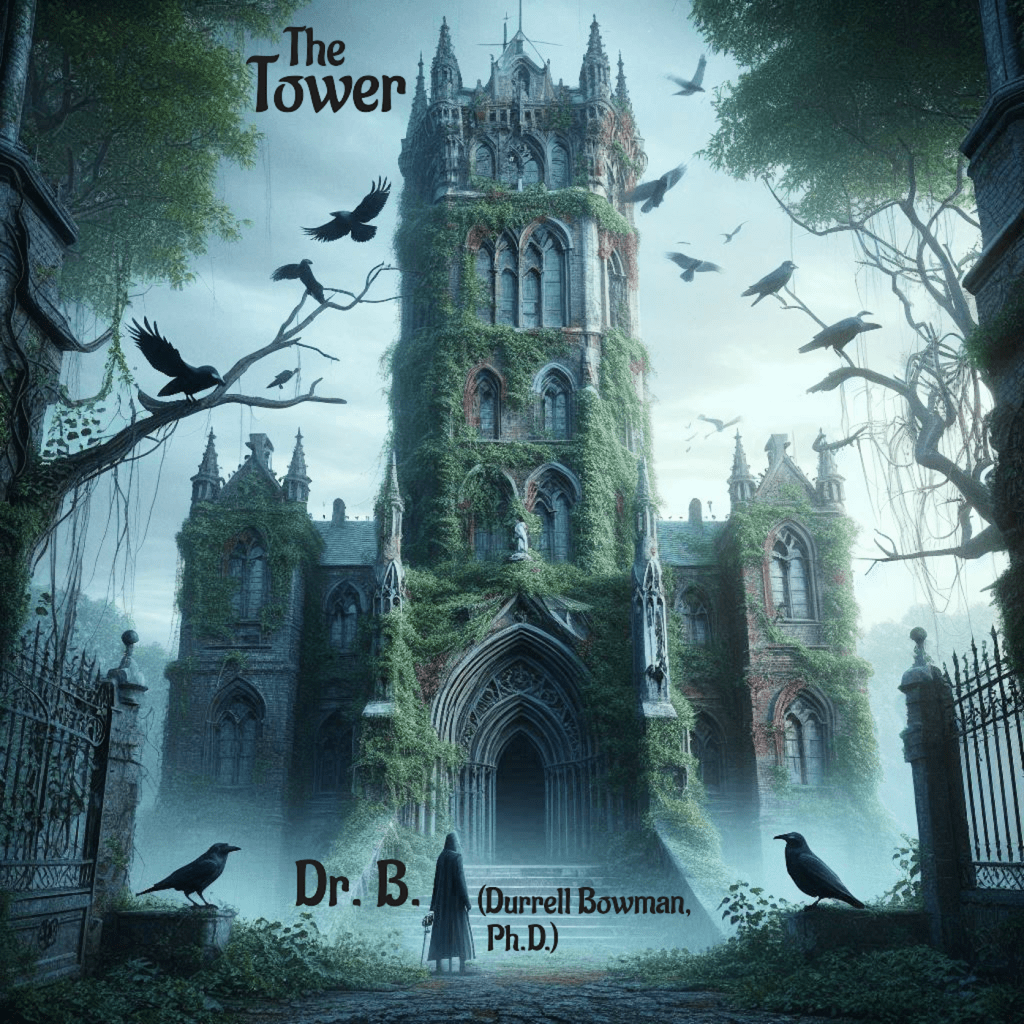
“The Tower” (concept album)

Featured

album cover of "The Tower" (concept album) - by Dr. B. (Durrell Bowman, Ph.D.)

Welcome to The Tower – by Dr. B. (Durrell Bowman, Ph.D.), 2024, 47:05: a Progressive, Pop-Rock, Experimental-Electronic Concept Album about One Person’s Path into and Exit from Higher Education. It’s available for streaming and/or download for $7 Canadian (approximately $5 US) on Bandcamp. You can choose to pay more, if you want to. Some of the eleven songs are new or new-ish, but often evoking certain existing styles and/or artists … especially from, say, 1969 to 1984. (I guess that’s my “Eras!” 🤪) Some of the songs are not so recent (one is as old as high school old!), but re-written with new words and re-arranged. The three weirdest pieces were composition-course projects to which I’ve now added words and vocal effects.

Continue reading

Ph.D. Parents and the Tenure-Track

https://www.nature.com/articles/s41562-022-01425-4 (“Socioeconomic roots of academic faculty”)

In the US, “faculty are up to 25 times more likely to have a parent with a Ph.D. Moreover, this rate nearly doubles at prestigious universities and is stable across the past 50 years. Our results suggest that the professoriate is, and has remained, accessible disproportionately to the socioeconomically privileged … .” It must be similar in Canada.

In the field of history (their humanities’ example), 26.7% of tenure-track professors have at least one parent with a Ph.D., and 34.3% have at least one parent with a master’s degree. Professors are 25.3 times more likely to have a parent with a Ph.D. than the general population does, whereas all people with Ph.D.s are merely 1.9 times as likely to have such a parent. Both cases, but especially permanent faculty members, approach zero in having–like me–high school completion as the highest level of study of either parent.

It’s unusual for someone of my lower socioeconomic background to have completed a Ph.D. at all and not in any way surprising that I didn’t become a tenure-track professor. It would have been several hundred times as unlikely for me to become a professor compared to people with at least one Ph.D. parent. Ethnicity is rightfully discussed as an important factor in these issues, but I am white, and socioeconomic status is also a major factor.

Academic Lawsuit

https://globalnews.ca/news/9753491/mcgill-instructor-lost-job-lawsuit-diversity/amp/.

There are tens of thousands of us out here wishing we could each sue the academic institutions that didn’t hire us for tenure-track positions. That’s especially the case for instances in which we were short-listed, did multi-day campus interviews (sometimes in another country), and so on. Most of us have already been left behind by academia. This guy should get over himself and move on.

Graduate School and Alternative Career Paths

I find it amazing that academia abandons tens of thousands of people every year and that some fields have almost no contexts for other types of career paths. I wish I had pursued an alternative career path as much as twenty years ago. In addition, if I had never pursued graduate school at all, I could have started working as a Customer Service Representative for the Liquor Control Board of Ontario, an Order Support Agent for a call centre, or a Rural & Suburban Mail Carrier for Canada Post in my twenties and been approaching early retirement by now. I also wish I had continued composing music to a much greater extent after my twenties. I’m 56, have a Ph.D., and have accomplished a great deal, but I have never had any kind of continuing full-time job that pays a living wage.

Alternative-academic and non-academic career paths—and ways to collaborate both with other scholars and with those outside academia—should be discussed and enabled. Those considerations should begin during the time-frame when doctoral candidates have traditionally worked on remarkably narrow concerns in their doctoral seminars, research and teaching assistantships, exams, and dissertations. Fewer people should complete doctorates and attempt to become professors. Post-secondary education usefully establishes and consolidates one’s interests, as well as the ability for critical thinking. However, pursuing it beyond a bachelor’s or master’s degree is unnecessary. I wish I had realized that a long time ago.

Combined Master’s-PhD

Graduate school should only exist as fully-funded PhD programs in which students complete their courses, exams, and teaching and/or research assistantships in the first two years and their modest-scope dissertations in the third and fourth years. Each graduate student should then be required to complete a two-year professional development master’s degree, in consultation with a career centre and including a paid internship. That work could be done in teaching (at any level), business, public writing, lab work, communications, government services, website development, library & information science, or some other area. Everyone would need to do that master’s degree before actually being awarded his or her PhD!