“9” (movie)

I just saw the weird “puppet” movie 9, which I’ve decided to rename The Wizard of Pinocchio: The Rise of the Machines. It’s visually inventive, but the story is rather incoherent and a mish-mash of various and–one should have thought–incompatible influences, such as a mysterious scientist who inadvertently sets nasty things in motion, puppets who try to become heroic, Judy Garland’s original performance of “Over the Rainbow” (The Wizard of Oz) underscoring an extended scene, and Terminator-like near-future machines trying to blow up everything and everyone. As with District 9, it was derived from a young filmmaker’s short film and backed by a major director/producer, in this case not Peter Jackson, but Tim Burton.

Academia

Recent thoughts about Academia:

  • Here’s an example of how silly academic music job postings can be: “Primary responsbilities include teaching music theory, musicianship, composition, musical instrument digital interface, and low brass private lessons.”
  • Academia in the humanities exists so that many of the 50% who are lucky enough to get “permanent” jobs can move around to better jobs, whereas the other 50% never get to have permanent jobs at all.
  • On the other hand, a dissertation is an elaborate information system, developed through an iterative and incremental life cycle. In other words, that’s pretty similar to what systems analysts do! So, maybe there is hope for me in my new proposed career in computer applications development.

“This Beat Goes On”

The second-half of Nicholas Jennings’ CBC rock-doc This Beat Goes On (about 1970s’ Canadian rock music) was not very good at all.

The only way punk, post-punk, and new wave music make any sense historically OR stylistically is by comparison to the progressive rock, arena rock, heavy metal, and so on that preceded them. This second episode did not follow properly at all from the first one (which reasonably covered the Guess Who, BTO, Gordon Lightfoot, Harmonium, and many others) and instead dove right off the top into DOA, the Viletones, Teenage Head, etc., then covered Top 40 soft pop-rock, and then finally touched on Rush, Max Webster, etc. in the last couple of minutes. I’m not saying that hard/prog needed more airtime, but the filmmakers might as well have covered DOA in the show’s first episode and the Guess Who in a later episode, for all the sense this episode made.

I like the way they’re presenting lots of groups that people under thirty or so probably have never heard (or seen). However, the already-well-known entities (even Bruce Cockburn, but also Rush and way too many others) are just getting their best-known songs covered (any of which you can hear on classic rock radio any day of the week), rather than their much more interesting work, which would have presented them in a much better light in the context BOTH of obvious Top 40 pop songs AND of punk/post-punk/new-wave music.

They haven’t really done any better with this than the low-end fillers they usually have on VH1 and MuchMore(of-the-same)Music, and I find it hard to believe that they spent three years on it. Jennings is a light-weight: what Canadian music needs is a Malcolm Gladwell to distil what has been written about Canadian music by academics—but for a mass audience.

“Californication”

I like Californication (2007- ), except that it certainly does propagate the unreasonable characterization that everyone in LA is so good-looking. I suppose the Venice Beach area is well above average in this respect, though! I remember David Duchovny (this show’s Hank Moody) notoriously giving interviews around the later years of The X-Files (that show’s Fox Mulder) that he loved watching porn, so I guess it’s somehow fitting that he ended up in such a naughty, sex-oriented, yet oddly-literary show.

Duchovny is well-suited to presenting something along the lines of self-loathing and a frequently-“mumbling” spoken presentation, both of which are also present in the character of Mulder. However, combined with the actor’s family and educational backgrounds (a teacher/administrator mother, a writer/publicist father, attending an independent NYC boys’ school, a B.A. in English/poetry at Princeton, and an M.A. and an incomplete Ph.D. in English literature at Yale), these characteristics actually conspire to work much better as applied to the character of a prematurely has-been writer than to the character of a “flaky” FBI agent.

Hank is vaguely aware of pop culture and self-consciously espouses retro-hipness, saying things such as “B to the I to the double-L” and preferring LPs and mid-’70s Bob Dylan, and he also disparages not only LA (favouring New York) but also the “non-literary” context of his current occupation: blogging. Moreover, the character’s unforced level of discourse can be as erudite as: “Is there another mode of egress?” when trying to sneak out of a girls’ high school. Even more than with Mulder, you can’t help but wonder: How much actual Duchovny is there written into fictional Hank?

“Inglourious Basterds”

Quentin Tarantino’s new film, Inglourious Basterds, is the closest thing he’s done to his 1994 masterpiece Pulp Fiction, not in terms of its content, but in terms of its form.

The film includes a number of “chapters” (with separate stories that come together towards the end), several extremely violent scenes, brutally wicked humour, and the music is again mostly from the 1960s, ’70s, and early ’80s–even though this story in set in Nazi-occupied France from 1941-44! This approach completely works, though, in a “suspending disbelief” parallel to the hilariously-mispelled words of the film’s title, which were borrowed from the correctly-spelled title of a relatively obscure, 1978 Italian WW2 film.

Language and dialogue again play major roles in this film, often with beautifully-spoken German and French (usually subtitled) by highly-compelling European actors–men and women. There are even a couple of voice-only cameos by Pulp Fiction alumni Samuel L. Jackson and Harvey Keitel. Musically, numerous “spaghetti western” cues are used (some actually by Ennio Morricone), but even the film’s use of distorted rock guitar cues and of David Bowie’s 1982 song “Cat People (Putting out Fire with Gasoline)” do not seem at all out of place.

I wouldn’t possibly want to spoil the film’s story, characterizations, “extreme moments,” jokes, and so on here, but if you appreciate Tarantino’s earlier work (especially Pulp Fiction), can handle the violence, and don’t mind a highly fictional story interwoven with versions of several extremely real people (especially Hitler and Goebbels), then I would highly recommended this film.

“The Time Travel(l)er’s Wife”

The Time Traveler’s Wife (the third word must be pronounced “truh-vee’-ler’s,” as far as I’m concerned) was merely OK, I guess, to pass the time–and I only paid $4.20 to see it. I suppose the story is meant to be a metaphor for absent spouses (or something “profound” along those lines), but with all the time-jumping there is almost no coherent character development at all, so it doesn’t really work as romance or as science-fiction or, really, as anything. It must work much better in the book upon which it’s based, but I’m not inclined to find out.

One of the more annoying things about the film is that it was meant to be released last November, and it thus begins and ends around Christmas and New Year’s and also prominently features the German Christmas carol “Es ist ein Ros entsprungen”–all of which just completely does not work for a film release in sweltering August. (My guess is that they will attempt to rush out the video for pre-Christmas, later this year.) Apparently, they had to do some major-scene reshoots (never a good sign!), but they had to wait until Eric Bana had grown his hair back after being the bald-bad-ass Romulan, Nero, in Star Trek and for the correct season to come around again. (Bana’s hair, or lack of it in Star Trek, oddly “stars” in both films.) As the time-traveller, he is semi-naked a lot, although you never actually really ever see more than his chest and, occasionally, his fleeting ass. He’s also in Funny People (an even worse film), so he’s kind of the “overexposed” (in some cases, literally) actor of summer 2009, something like Jude Law was five to eight years ago.

Bana’s co-star, pretty Canadian actress Rachel McAdams, was earlier in the romance film The Notebook (which no doubt inspired her being cast as the time-traveller’s wife), and she was the victim in the thriller Red Eye, as well as being in the comedies Mean Girls and Wedding Crashers. Speaking of people and things Canadian, I noticed Toronto’s Roncesvalles/High Park and Queens Quay areas (etc.) pretending to be Chicago, and apparently parts of the film were also done in Hamilton, Ontario. The score is by frequent Atom Egoyan collaborator Mychael Danna (who, as his brother Jeff told me in June, has recently moved back to Toronto from LA). The score was actually recorded in LA, though. Also, the occasional classical singing heard in the film is provided by Canadian operatic soprano Isabel Bayrakdarian, and the Toronto band Broken Social Scene appears as a wedding cover band, performing (in what must be the worst wedding song selection ever) Joy Division’s “Love Will Tear Us Apart Again.”

For multiple versions of the same character, instead see the much better current science-fiction film Moon. For incorporations of 1980s’ British gloom-rock, instead see the much better current “relationship” film 500 Days of Summer.
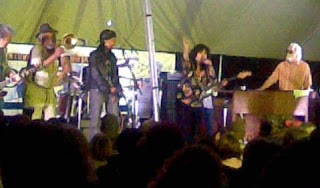
The Kitchener Blues Festival

The Kitchener Blues Festival was great, despite the rainy weather. Within a few hours, I heard Ronnie Hawkins & the Hawks (chaotic, with three guitarists and two keyboardists), Maria Muldaur (largely “swampy” Louisiana country/gospel-y blues), Leon Redbone (mostly olde-timey songs, along with a pianist), and Elvin Bishop (excellent band, including lead vocals by most of them).

Grove music articles

My Grove Dictionary of American Music articles on Canadian, US, etc. film composers from June and August of 2009:

  • Howard Shore
  • Michael Danna
  • Jeff Danna
  • John Debney
  • Michael Kamen
  • James Horner
  • Hans Zimmer

“EMC” music articles

My Encyclopedia of Music in Canada articles from June and July of 2009:

  • Film Scores
  • EMI Music Canada (formerly Capitol Records – EMI of Canada)
  • Sony BMG (formerly BMG) Music Canada
  • Warner Music Canada
  • Universal Music Canada
  • CBC Recordings
  • Music Industries
  • Calgary Philharmonic Orchestra
  • Manitoba Chamber Orchestra
  • Ken Whiteley
  • Country Music
  • Jim Cuddy
  • Michael Buble

500 Days of Summer

In 500 Days of Summer, I was amazed at how certain aspects of it are so “oldey-timey.” Even its scattered use of meditative voice-over and its use of a certain pop-rock songs are quite retro, the latter featuring not only the Smiths’ “There is a Light That Never Goes Out” (1986), but also a hilariously cheesy fantasy sequence making use of Hall and Oates’ “You Make My Dreams (Come True)” (1980) and even reasonable integrations (?!) of karaoke performances and arguments for Ringo Starr as the “best Beatle.”

As with so many of Woody Allen’s movies, this film has surface features of being a “romantic comedy,” but it’s actually far more philosophical than anything even remotely along those lines these days. Basically, a young woman (Zooey Deschanel) doesn’t want a serious relationship with a smitten young man (Joseph Gordon-Levitt) but “plays” with him for a while anyhow. However, the tone of the film, despite a few somewhat extreme moments (including its opening “dedication”), is surprisingly not really depressing or vindictive at all.

Despite the semi-retro vibe of parts of the movie, it is also set in a reasonable version of the present and in a gently post-modern, time-shifting way, as directed by former music-video director Marc Webb. It also features usually-underplayed aspects of Los Angeles, such as green spaces, architecture, park benches, “everyday” business, public transit, and relatively normal people. I’ve lived there for six years, so I know perfectly well that it’s not all movie stars and freeways, in the same way that I know perfectly well that 1980s’ music isn’t all about Madonna videos.