Ticketmaster/StubHub – Who’s Selling What Now?

When I joined the Ticketmaster queue at 12:00 noon today, 6566 “people” were ahead of me to buy tickets in the summer 2026 Rush: Fifty Something pre-sale. So, the pre-sale probably accounted for most of the venue’s seats, and what I encountered was just for the second day out of the four in Toronto. Theoretically, there were tickets for as low as $137.75.

I joined the waiting room within seconds of it opening at 11:30. At 12:05 (in the queue for 5 minutes), it indicated that $137.75 and $173.25 tickets were limited. Clearly, StubHub, TicketSmarter, etc. reseller bots beat me in the waiting list / queue and bought up all the cheap seats first, to sell them at higher prices.

After 12 minutes, there were still 2946 “people” ahead of me, and tickets were by then “very limited.” After a 20 minute wait in the queue, the cheapest seats available to me were $417 each. After another 3 minutes, the cheapest were $608.73 each. After another 2 minutes, the cheapest thing was a hotel/tickets package for two at $1478.91.

StubHub very quickly had new tickets available for the same show on the same day, and the lowest price I saw within an hour was $380 each. A few hours later, it was $431, and StubHub also seemed to know that the event was 88% sold out. Why would a reseller know that, unless it had scooped up basically all of the tickets and replaced Ticketmaster as the seller?

I will try for tickets up to $200 again on Friday, when Ticketmaster’s “general public” sales open. I fully expect things to happen much the same as today. However, I will do a more direct comparison of actual seat-price levels on Ticketmaster and on StubHub. My guess is that their resellers are more than doubling the prices.

The US, Canadian, UK, and other governments need to put an end to the obvious “insider trading,” “antitrust,” scalper-bot shenanigans going on at Live Nation / Ticketmaster / StubHub / TicketSmarter, etc. Even if it’s currently legal, it certainly is not ethical. Actual humans should be able to buy actual tickets at the actual prices.

The Tower (concept album)

I’m still very slowly working on my concept album The Tower (about the various problems with higher education), but I’ve moved beyond “concepts of a plan” to an actual plan. I know what all ten songs are (plus the “bonus track,” which is lyrically only tangentially related to the concept), what 95% of their words are, and what style they’re in. Some are based on much earlier songs and instrumental pieces of mine (but with new lyrics and/or added spoken words), and some are entirely new songs.

It’s going to be very “old school” (say, 1969 to 1984) experimental/electronic music and progressive rock influenced, keyboard-based, classic rock and pop-rock sounding. Parts of it have influences from Tangerine Dream, Supertramp and the Who, David Bowie and Peter Gabriel, Ultravox (probably, contingent on finding certain late-’70s/early-’80s synth and electronic drum sounds), Rush (I like switching into 7/4, etc.), and Laurie Anderson (I’ve figured out pitch shifting, but vocoding so far remains a mystery to me).

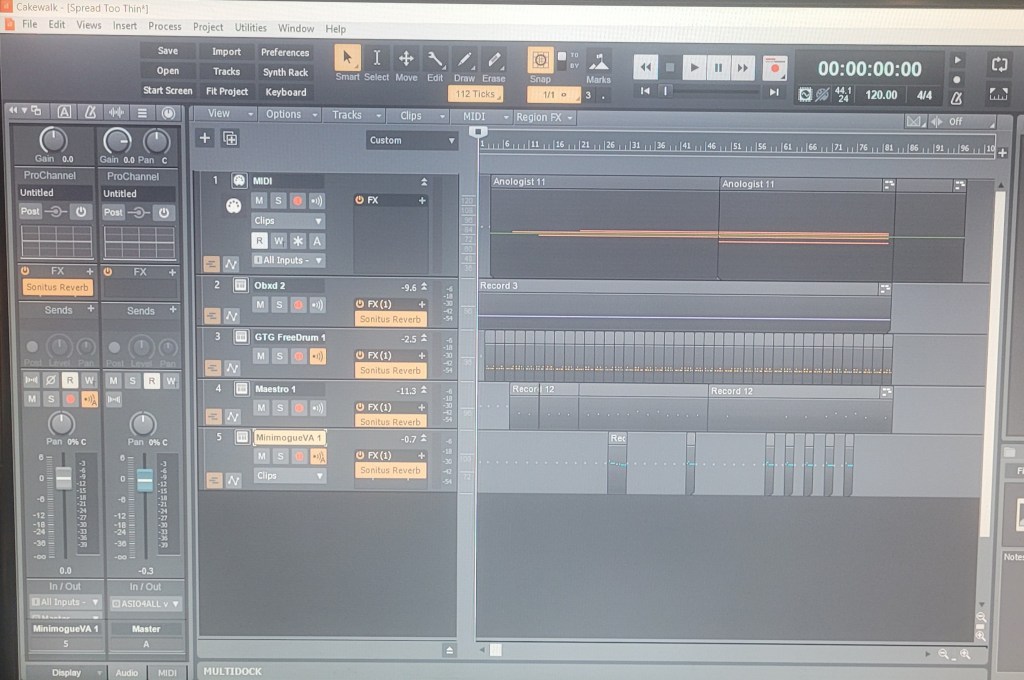
I’m using the free (!) Digital Audio Workstation / DAW called Cakewalk, and I use freely available soft synths and other sounds from a variety of sources. Just to give a sense of what this crazy, elaborate type of software is like, here are photos of the first two songs (“Spread Too Thin” and “The Ivory Tower’s Crumbling”), but still without vocals added.

Songwriting and Performing

My songwriting and live performing have converged into using my semi-weighted controller keyboard (which was a gift from Vicky and others some years ago), my DAW (digital audio workstation) software, and numerous virtual instruments and effects. Today, I figured out how to make live song files that map different instruments as splits and layers across 88 keys. There are easier ways to do it, but this way I didn’t have to purchase a digital piano or VST host software. In fact, I didn’t spend anything; even my DAW (Cakewalk by BandLab) was free!

Burt Bacharach

I’m a bit late acknowledging Burt Bacharach’s passing last week. However, one of my earliest memories, along with watching the Apollo 11 moon landing on TV, was hearing B. J. Thomas’s recording of Bacharach and Hal David’s “Raindrops Keep Fallin’ on My Head” on the radio. I did eventually see the movie for which it was written: Butch Cassidy and the Sundance Kid. Unfortunately, I somehow eventually became a musicologist. Happiness did not step up to greet me.

Conference Paper – Rush’s “Hemispheres” – Progect 2021

Here’s a link to my online conference paper bio, abstract, and video for “Rush’s ‘Hemispheres’: Uniting Heard and Mind (and Progressive Rock with Heavy Metal)”. May 2021 Progect Conference, hosted by the University of Ottawa.

https://progectconference2.wixsite.com/website-5/durrell-bowman

Abstract:

If progressive rock and heavy metal sometimes appropriate ideas from classical music—instead of, say, the blues—would that be enough to explain their appeal? Of course not. If they’re often musically and lyrically “complex,” are these complexities straightforwardly more so than the underlying grooves and vocal practices of funk and hip hop? Well … no. On the other hand, even though they may not reach a particularly diverse audience, progressive rock and heavy metal actually espoused eclecticism right from the start. 

The Canadian rock band Rush (1968-2018)—one of the godfathers of progressive metal—would not have developed an eccentric, eclectic progressive/hard style without the example of musicianly progressive rock from 1969-77. However, the band’s music also relates to the influence of blues-oriented hard rock and power-oriented heavy metal from the same period. Rush’s 1978 album Hemispheres begins with its title-track, and with it the band provided its last of three album-side-length compositions. “Hemispheres” establishes a conflict between the left (thought or “reason-oriented”) and right (emotion or “feelings-oriented”) halves of the human brain. The band anthropomorphizes these according to classical/mythological references to the gods Apollo and Dionysus, respectively. 

The paper explores the large-scale design of Rush’s “Hemispheres,” including its sections, form, metrical construction (including 12/8 and 7/8), lyrical features, and tonal complexities. The latter include extended chords, inversions, cross-relations, chromaticism, modes, ambiguous progressions, and various solutions to a particular cadential figure. Among other things, Rush uses nearly identical music to equate a pair of extended lyrical frames as equally inadequate ideologically. The band then converges on additional musical and lyrical frames that themselves become a reconciliation. In this manner, Rush mythologizes the post-counterculture of needing to unite heart and mind into something new.

“Cut Every Corner: Intertextuality and Parody in the Music of The Simpsons” (journal article)

My journal article, “Cut Every Corner: Intertextuality and Parody in the Music of The Simpsons,” appears in the 2020 “Parody: Intertextuality and Music” issue of MUSICultures.

https://journals.lib.unb.ca/index.php/MC/article/view/31402

“Shary Bobbins”
“Cut Every Corner”
MUSICultures, Vol. 47 (2020)

Abstract

This article reworks ideas about parody, postmodernism, and television from such critical and cultural theorists as Linda Hutcheon, Jason Mittell, and Jonathan Gray to contextualize the wide variety of parody and intertextuality in the music of the animated TV show The Simpsons. It explores several categories of the show’s music, such as: variations of cartoon themes, songs, instrumental underscoring, and guest musicians. This article particularly uses specific episodes of The Simpsons to highlight parodies of the show’s own theme, movie music, themes from other TV shows, and so on. The show’s music thus functions as a kind of court jester or king’s fool.

Academic Research and Writing

Of the eighteen people contributing to the forthcoming Cambridge University Press book on progressive rock, sixteen are university-affiliated academics (so it would be reasonable for them to expect to do such things as a part of their employment), one is VP of Education at the Rock and Roll Hall of Fame and Museum, and one is a computer technology order support specialist making the equivalent of about $11 U.S. per hour. Guess which one resents doing academic research and writing for free, given that it has nothing to do with his employment?

Two (Three) Guys Talking Rush

I show up at around 22:50 minutes.

Neil Peart, RIP

I always sort of hoped that Rush’s drummer-lyricist Neil Peart and I would cross paths at some point and have an interesting conversation. We both first lived on family farms in Ontario, our fathers both worked at International Harvester dealerships, we both wrote multiple books (much of my work being about Rush’s music), we are both Canadians who lived in Los Angeles for a time, he was nicknamed “The Professor,” and I actually once was a Visiting Assistant Professor. Rush’s music is not everyone’s cup of tea, but the complexity (definitely present in the drumming), the constant stream of influences (lyrical and musical), and the work ethic were remarkable. Please consider giving a monetary gift in his memory to a cancer charity of your choice. RIP, Neil.