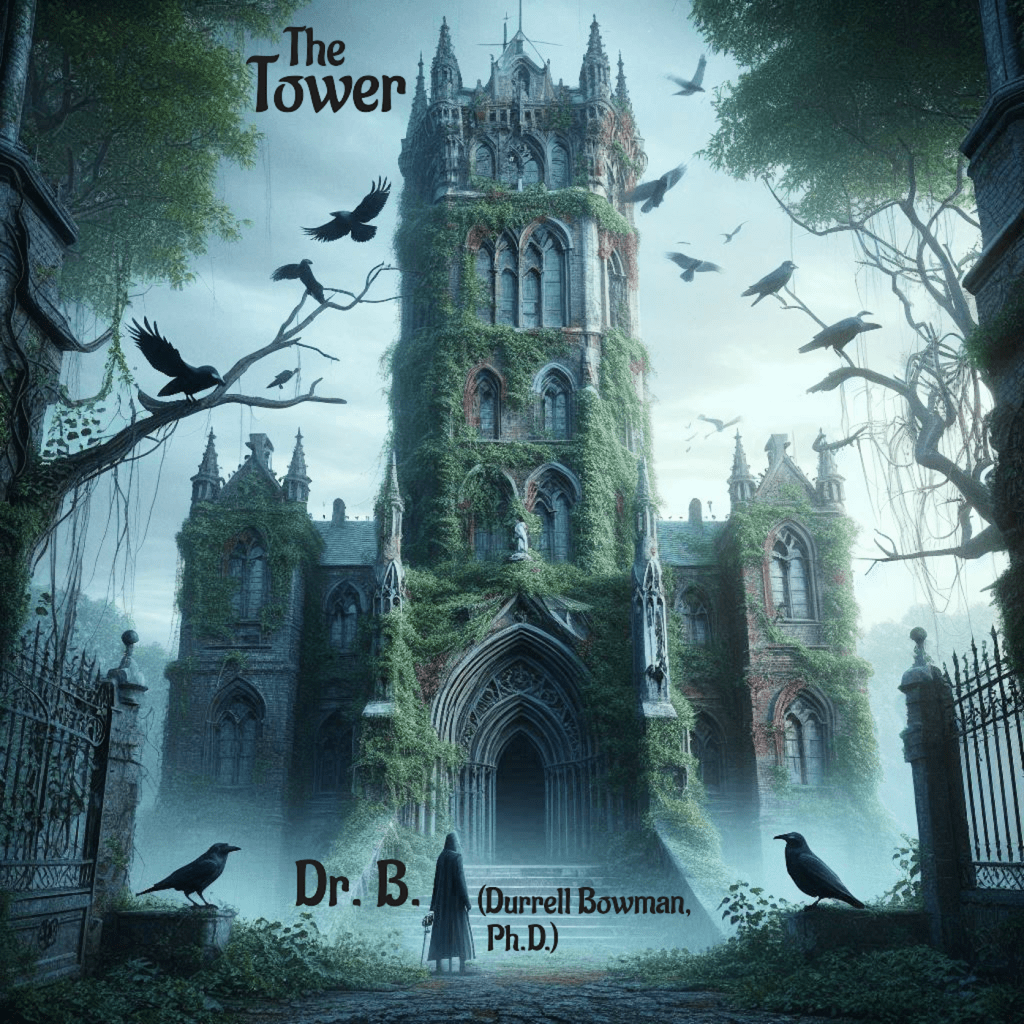
Welcome to The Tower – by Dr. B. (Durrell Bowman, Ph.D.), 2024, 47:05: a Progressive, Pop-Rock, Experimental-Electronic Concept Album about One Person’s Path into and Exit from Higher Education. It’s available for streaming and/or download for $7 Canadian (approximately $5 US) on Bandcamp. You can choose to pay more, if you want to. Some of the eleven songs are new or new-ish, but often evoking certain existing styles and/or artists … especially from, say, 1969 to 1984. (I guess that’s my “Eras!” 🤪) Some of the songs are not so recent (one is as old as high school old!), but re-written with new words and re-arranged. The three weirdest pieces were composition-course projects to which I’ve now added words and vocal effects.
Continue readingCategory Archives: Higher Education
The Tower (concept album)
I’m still very slowly working on my concept album The Tower (about the various problems with higher education), but I’ve moved beyond “concepts of a plan” to an actual plan. I know what all ten songs are (plus the “bonus track,” which is lyrically only tangentially related to the concept), what 95% of their words are, and what style they’re in. Some are based on much earlier songs and instrumental pieces of mine (but with new lyrics and/or added spoken words), and some are entirely new songs.
It’s going to be very “old school” (say, 1969 to 1984) experimental/electronic music and progressive rock influenced, keyboard-based, classic rock and pop-rock sounding. Parts of it have influences from Tangerine Dream, Supertramp and the Who, David Bowie and Peter Gabriel, Ultravox (probably, contingent on finding certain late-’70s/early-’80s synth and electronic drum sounds), Rush (I like switching into 7/4, etc.), and Laurie Anderson (I’ve figured out pitch shifting, but vocoding so far remains a mystery to me).
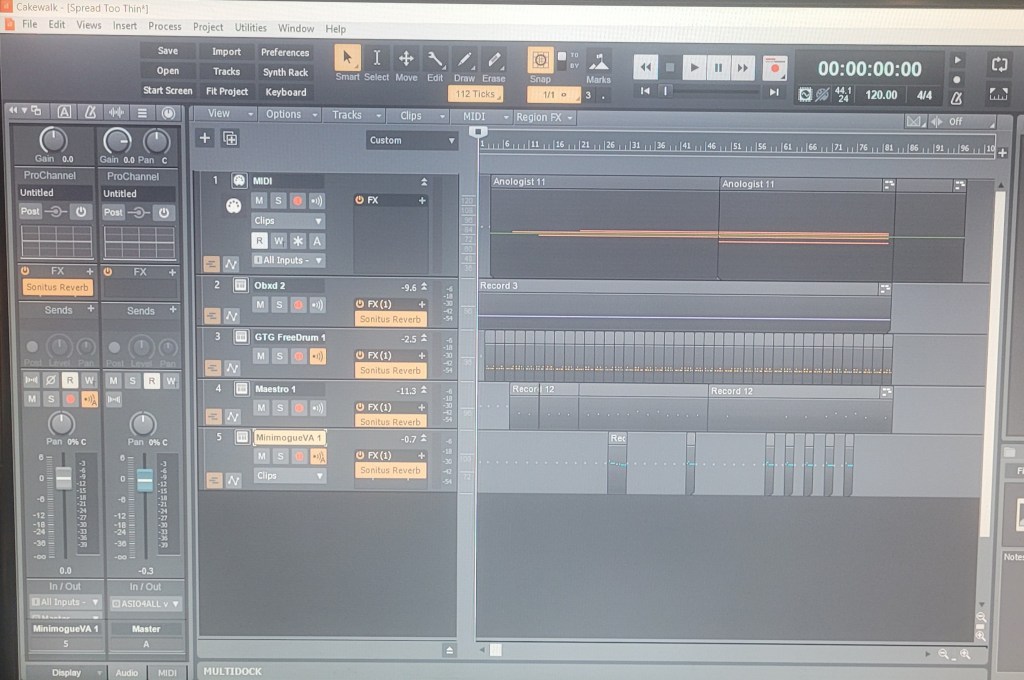
I’m using the free (!) Digital Audio Workstation / DAW called Cakewalk, and I use freely available soft synths and other sounds from a variety of sources. Just to give a sense of what this crazy, elaborate type of software is like, here are photos of the first two songs (“Spread Too Thin” and “The Ivory Tower’s Crumbling”), but still without vocals added.


The Purge, 2024
Imagine painstakingly collecting several hundred academic and other books and thousands of research and teaching documents and other things over about thirty-five years, keeping all that in storage, and then having nowhere to keep it anymore and getting rid of about 90% of it into recycling, trash, and thrift store donations.
Sports vs. Academia
I like the PWHL, and I also like that its player salaries are in a reasonable range for what is, after all, just a game: from $35,000 to $80,000 US (averaging $55,000, or lower middle-class). On the other hand, if it’s going to sell out Toronto’s Scotiabank Arena, perhaps it could try to double that, so all professional women hockey players would be at least solidly middle class and only some of them above that. If the NHL’s salaries didn’t range from $750,000 to $12.6 million US (averaging $3.5 million), I might also take it seriously. Not to mention football, baseball, basketball, etc.
It’s too bad other professions, also with highly-credentialed/experienced/talented people, can’t be bothered to guarantee an annual income of at least $35,000. Instead, organizations such as academic societies give amounts on the order of $500 a year to a handful of unaffiliated scholars. That doesn’t even cover the cost to attend a national or international scholarly meeting, let alone pay anyone anything like a month’s rent. Academic publishers also continue to expect people to write book chapters and journal articles without paying them anything. They should at least find money to pay people who don’t have any related income coming in.
Ph.D. Parents and the Tenure-Track
https://www.nature.com/articles/s41562-022-01425-4 (“Socioeconomic roots of academic faculty”)
In the US, “faculty are up to 25 times more likely to have a parent with a Ph.D. Moreover, this rate nearly doubles at prestigious universities and is stable across the past 50 years. Our results suggest that the professoriate is, and has remained, accessible disproportionately to the socioeconomically privileged … .” It must be similar in Canada.
In the field of history (their humanities’ example), 26.7% of tenure-track professors have at least one parent with a Ph.D., and 34.3% have at least one parent with a master’s degree. Professors are 25.3 times more likely to have a parent with a Ph.D. than the general population does, whereas all people with Ph.D.s are merely 1.9 times as likely to have such a parent. Both cases, but especially permanent faculty members, approach zero in having–like me–high school completion as the highest level of study of either parent.
It’s unusual for someone of my lower socioeconomic background to have completed a Ph.D. at all and not in any way surprising that I didn’t become a tenure-track professor. It would have been several hundred times as unlikely for me to become a professor compared to people with at least one Ph.D. parent. Ethnicity is rightfully discussed as an important factor in these issues, but I am white, and socioeconomic status is also a major factor.
Academic Lawsuit
https://globalnews.ca/news/9753491/mcgill-instructor-lost-job-lawsuit-diversity/amp/.
There are tens of thousands of us out here wishing we could each sue the academic institutions that didn’t hire us for tenure-track positions. That’s especially the case for instances in which we were short-listed, did multi-day campus interviews (sometimes in another country), and so on. Most of us have already been left behind by academia. This guy should get over himself and move on.
ChatGPT
https://openai.com/blog/chatgpt

There’s a meme going around about artifical intelligence (AI) software actually being plagiarism software, but that’s not really what’s going on.
I’ve used ChatGPT to see what it would do. For topics where there’s a lot of info out there, it’s maybe 80% on point, but genericizes the info, has no particular (or at least no strong) “thesis,” shows no evidence of research, provides no references (and can’t if you ask it to), and is poorly written. So, all of that is similar to a high school or early undergrad essay that would probably get a C or D.
If it directly took sentences from somewhere without citing them, that would be plagiarism/fail/F, but I don’t find that’s usually what it does. It’s more insidious than that.
On more obscure topics (even when the facts are out there in at least a few places), it makes up almost everything and is only maybe 20% accurate, in addition to many of the above problems. That’s not plagiarism, but it’s a definite fail/F.
The program is actually really good at coming up with poems and lyrics in the style of certain writers, but that is also not plagiarism.
Burt Bacharach
I’m a bit late acknowledging Burt Bacharach’s passing last week. However, one of my earliest memories, along with watching the Apollo 11 moon landing on TV, was hearing B. J. Thomas’s recording of Bacharach and Hal David’s “Raindrops Keep Fallin’ on My Head” on the radio. I did eventually see the movie for which it was written: Butch Cassidy and the Sundance Kid. Unfortunately, I somehow eventually became a musicologist. Happiness did not step up to greet me.
Graduate School and Alternative Career Paths
I find it amazing that academia abandons tens of thousands of people every year and that some fields have almost no contexts for other types of career paths. I wish I had pursued an alternative career path as much as twenty years ago. In addition, if I had never pursued graduate school at all, I could have started working as a Customer Service Representative for the Liquor Control Board of Ontario, an Order Support Agent for a call centre, or a Rural & Suburban Mail Carrier for Canada Post in my twenties and been approaching early retirement by now. I also wish I had continued composing music to a much greater extent after my twenties. I’m 56, have a Ph.D., and have accomplished a great deal, but I have never had any kind of continuing full-time job that pays a living wage.
Alternative-academic and non-academic career paths—and ways to collaborate both with other scholars and with those outside academia—should be discussed and enabled. Those considerations should begin during the time-frame when doctoral candidates have traditionally worked on remarkably narrow concerns in their doctoral seminars, research and teaching assistantships, exams, and dissertations. Fewer people should complete doctorates and attempt to become professors. Post-secondary education usefully establishes and consolidates one’s interests, as well as the ability for critical thinking. However, pursuing it beyond a bachelor’s or master’s degree is unnecessary. I wish I had realized that a long time ago.
Academic Work for Free
Spending hundreds of hours every year doing academic work on book chapters, journal articles, and conference papers when I don’t even have an academic job — and am thus doing it all for free — is highly exploitative. So, after my current projects wrap up in the next couple of months, I’m not going to do these things anymore. I want to do more academic research and writing, but the system is not set up to pay anyone directly. That needs to change.

