Discussion of “Class Struggle” (about part-time university instructors)

Re the CBC’s Most university undergrads now taught by poorly paid part-timers (includes an embedded player of the radio documentary):

Having a large part-time workforce of adjunct instructors is not an unfortunate consequence of under-funding universities.  It is a planned consequence of higher education trying to sustain too many programs, taking in too many students, and having way more non-faculty employees (administrators, etc.) than it has tenure-track and tenured faculty members.  Pat Rogers (of Wilfrid Laurier University) and Ken Coates (of the University of Saskatchewan, formerly of the University of Waterloo) have basically given up on higher education actually being for education.  “Saving money” for student residence climbing walls and whirlpools is now the priority, even though money is not actually saved, because of hiring a new administrator for every little thing.

The “statistic” about an adjunct (a.k.a., contingent, sessional, etc.) instructor making $28,000 to $45,000 a year for teaching the same number of courses (four) as a faculty member making $80,000-$150,000 is misleading.  Most adjunct faculty do not teach full-time:  I typically made around $16,500 for three courses per year.  Even as a Visiting Assistant Professor, I only made $22,000 for four courses.  Maybe things are different in STEM (Science-Technology-Engineering-Math), but adjunct instructors and faculty members in most disciplines simply do not make the kind of money indicated.  Also, numerous Ph.D.s eventually leave academia and become things like school bus drivers, real estate agents, yoga instructors, and welfare recipients.  Some of us also publish books and articles, present papers at academic conferences, and so on, but none of that provides a living wage.  Writing usually works out to less than minimum wage (not to mention that it’s only a part-time venture), and, in fact, presenting at conferences costs money.  Usually, it’s just faculty members who can get conference travel funds.

Most adjunct instructors continue to hold out hope for landing permanent academic positions, and they thus resist saying much about their circumstances of low pay, limited or no office use, no benefits, no pensions, and so on.  Conversely, most tenured and tenure-track professors won’t go on record on this issue, either, because they would almost invariably appear to be unsympathetic.  So, documentaries such as this one end up having to interview administrators, even though the over-hiring and over-prioritizing of them is one of the main problems in higher education today.  If you don’t believe that this is an issue, see also the Huffington Post’s New Analysis Shows Problematic Boom In Higher Ed Administrators.

Purchase “Experiencing Rush”

Please purchase a copy of Experiencing Rush: A Listener’s Companion
(October 2014) at Rowman & Littlefield (the publisher), Amazon.com (or a non-US Amazon, such as in Canada or the UK), Barnes & Noble, Chapters Indigo, or another book retailer. Thanks!

Experiencing Rush - full cover

Experiencing Rush – full cover

Big Moose Lake (vacation)

Standing near the dock at the lake

Standing near the Dock at the Lake (Big Moose Lake)

From August 1-8, I was on vacation in the Adirondacks in Upstate New York, staying at Vicky’s family’s “camp” (a.k.a., cottage) at Big Moose Lake. The camp was given to her grandfather (an attorney from Albany) for helping recover money lost by some inn-owning sisters. Big Moose Lake had also been the site of a notorious murder, in which a young man used the remote location to kill the young woman he had gotten pregnant. The story was transformed by Theodore Dreiser in his novel: An American Tragedy (1925) and then also further transformed (and re-set in California) in the classic Hollywood movie: A Place in the Sun (1951).

the Lucas/Orvis cottage at Big Moose Lake

the Lucas/Orvis camp (formerly called the “Hinman Cottage”) at Big Moose Lake

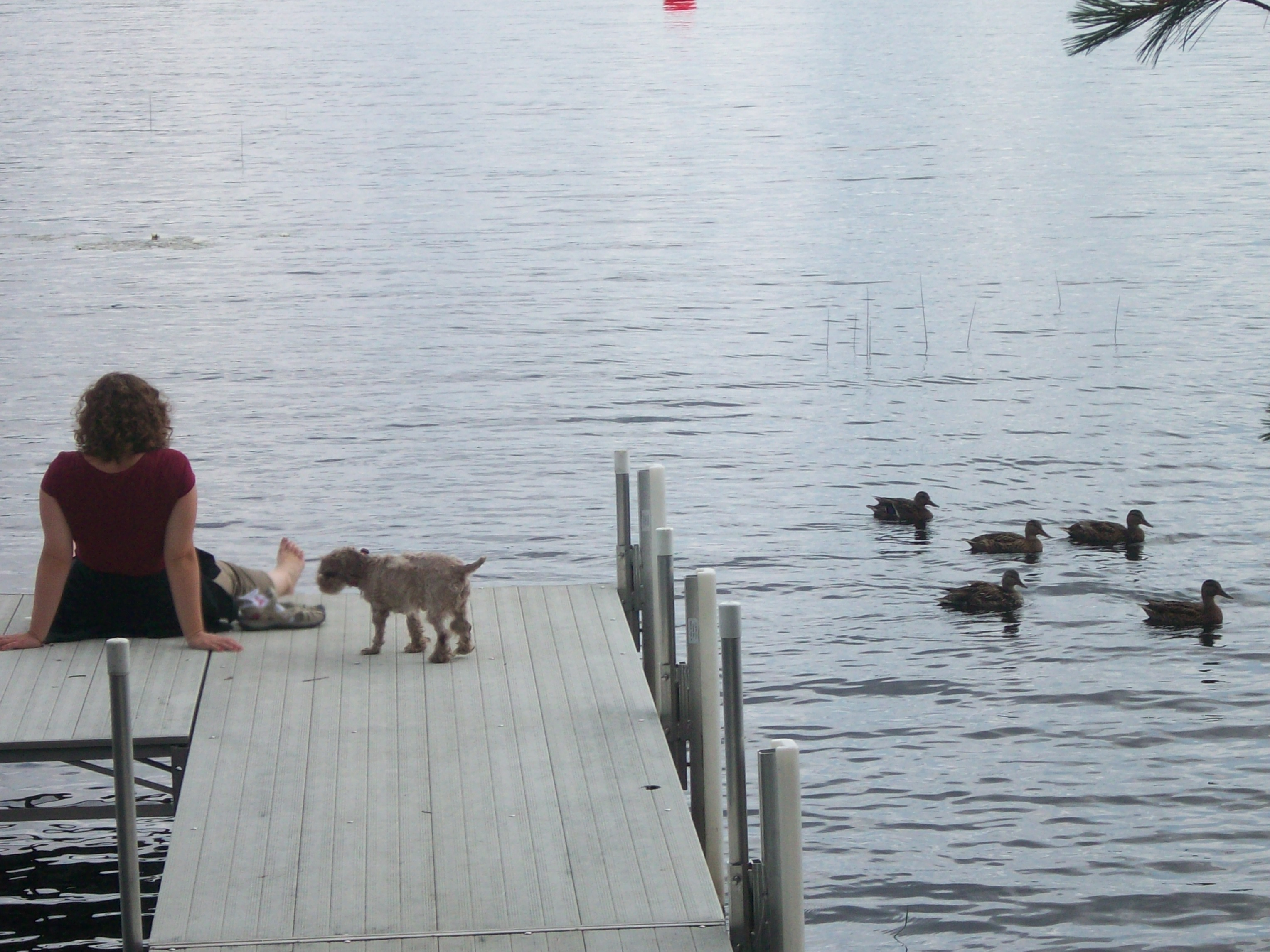
Emma, Dougal, and ducks

Emma, Dougal (miniature poodle), and passing ducks; loons were also commonly heard, especially early in the morning

living room

the living room, including a library, a stereo (mostly featuring a CD of “bear songs” for kids!, although NPR and a few other radio stations did come in), and an old Victrola

foyer, fireplace, staircase, kitchen and dining room in background

the front foyer, staircase to the upstairs bedrooms/bathrooms, Baylor (Vicky’s Irish Water Spaniel), and fireplace, with doorways to the dining room and kitchen in the background

We thought we’d be roughing it, because a tree had landed on the roof and cut out the power a few months earlier. However, the electricity had been back for a few weeks by the time we got there and was more properly repaired on one of the days we were there. On the other hand, there’s no cell phone service in the area (but there is a land line), limited internet access (sporadically from a nearby inn or by parking near the local fire station), and no TV (although some camps do have satellite dishes).

Big Moose Fire Station

Big Moose Fire Station

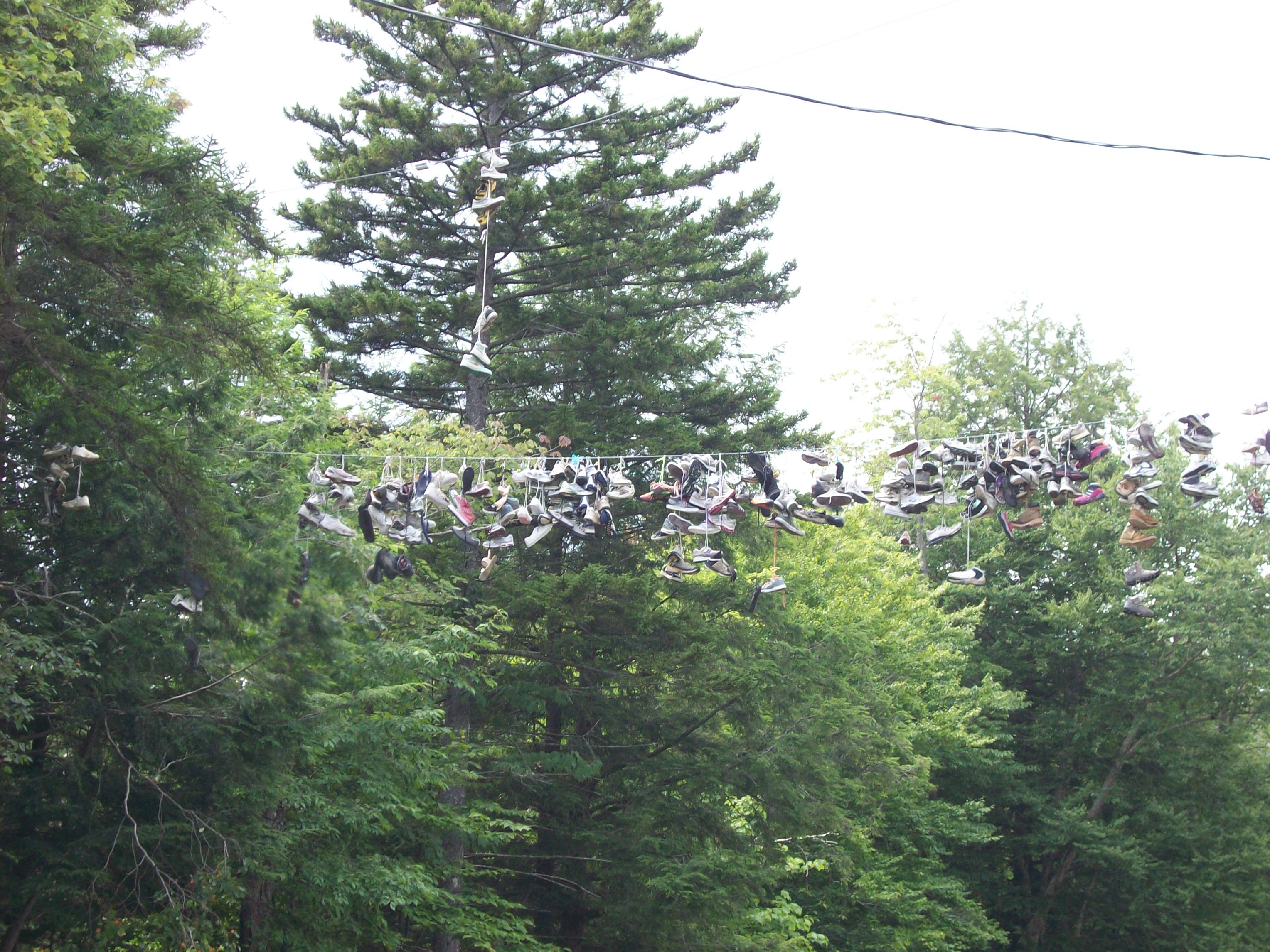
shoes hanging on wire

shoes hanging on wire, right beside the fire station (yes, that IS weird!)

The best option for internet, etc. is the nearby town of Inlet (a 20-minute drive), which has a public library, an excellent ice cream shop (Northern Lights), and other nice stores and a great restaurant (the Screamen Eagle). The next nearest town is Old Forge (about a 30-minute drive), and it is quite a bit larger.

an excellent ice cream shop in Inlet

the excellent ice cream shop in Inlet

I missed out on a fairly major hike on August 4 (Chimney Mountain), because I was trying to get over this swollen-gland and sore-throat thing and also had plantar fasciitis in my left foot. So, I hung out with Vicky’s two dogs, took some pictures, listened to a bit of NPR, and rested a lot. I also started reading this book I’ve been meaning to get through, as well as the Sunday, August 3 newspaper from Utica, brought by some additional family friends visiting from there.

Vicky with Jeannine and Tara (friends from Utica)

Vicky, with Jeannine and Tara (friends from Utica), August 3

much of the gang

much of the gang, including some of our Utica area visitors, August 3

When the others were around, I went to a craft sale at the Big Moose Community Chapel, helped with meal preps and cleanup, occasionally swam a bit (and/or floated on this plastic, inflatable island thingie), and so on.

Community Chapel craft sale

Community Chapel craft sale, August 2

Big Moose Community Chapel

Big Moose Community Chapel; it’s an historically-registered site

Community Chapel

Community Chapel

We got some nice photos behind the chapel and down by their dock.

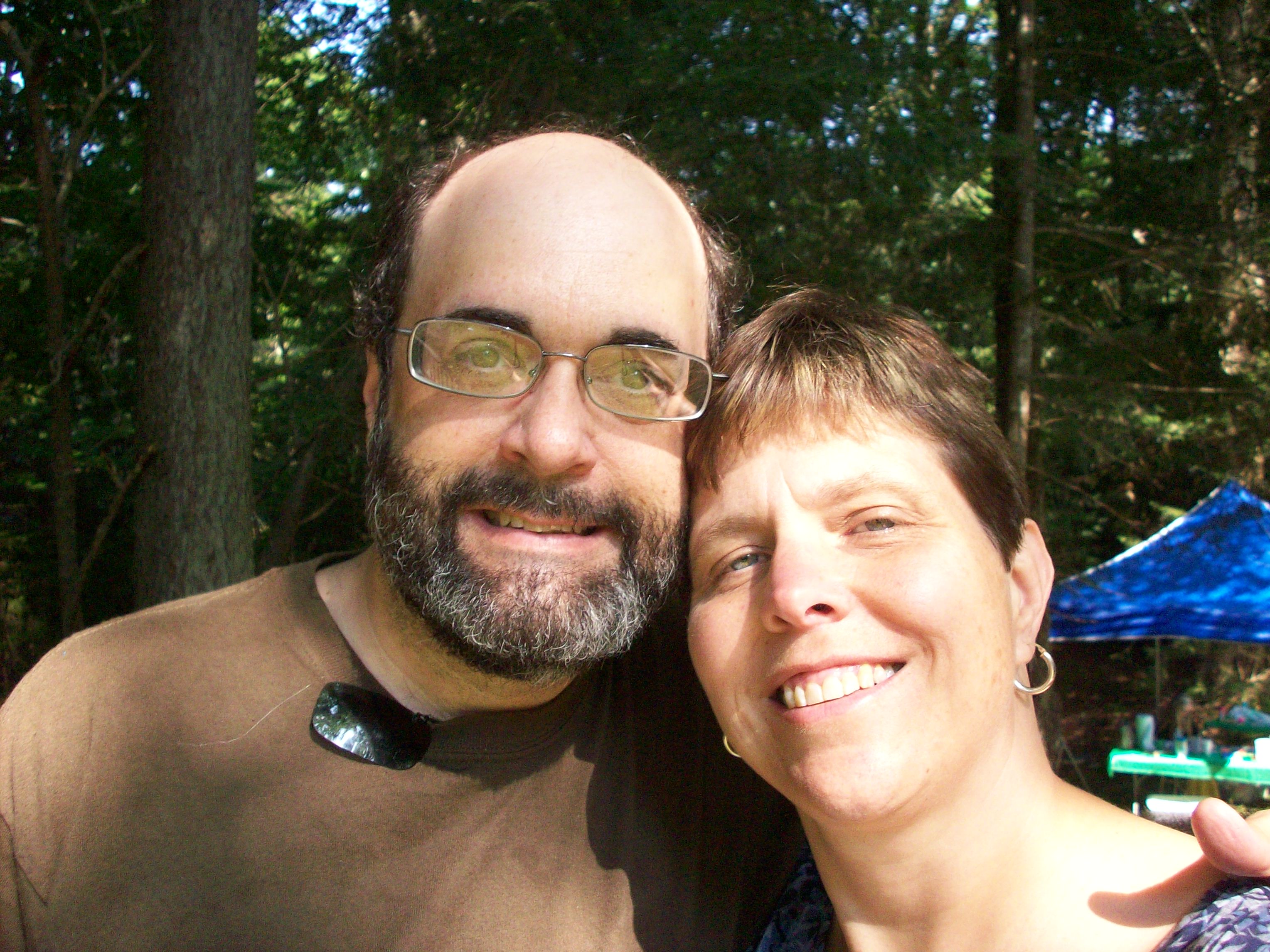
Vicky, the Queen of the two-person selfie!

with Vicky, the Queen of the two-person selfie!

2014_08_big_moose_lake-013.jpg

With Vicky near the dock at the Community Chapel on their craft sale day; I had just purchased that hat, in addition to a balsam-fir-scented decorative pillow; August 2

Miko (about to go kayaking?)

the Pyle’s big dog Miko (about to go kayaking?)

From mid-day August 5 until August 8, it was mostly down to three of us (Vicky, Emma, and me), except for a visit by Jeannine and her husband Charlie on August 7. On August 6, I joined Vicky and Emma for the hike up Bald Mountain.

"Bald" Mountain (no comment!)

“Bald” Mountain (no comment!)

2014_08_big_moose_lake-057.jpg

Vicky and Emma, halfway up Bald Mountain; this is the spot where they met Jeannine some years earlier

proper footwear, intertwined

proper hiking footwear, intertwined

the fire tower at the top of Bald Mountain

the fire tower at the top of Bald Mountain

Vicky at the top of the fire tower at the top of Bald Mountain

at the top of the fire tower at the top of Bald Mountain

from fire tower at the top of Bald Mountain

from the fire tower at the top of Bald Mountain

Bald Mountain

coming down Bald Mountain

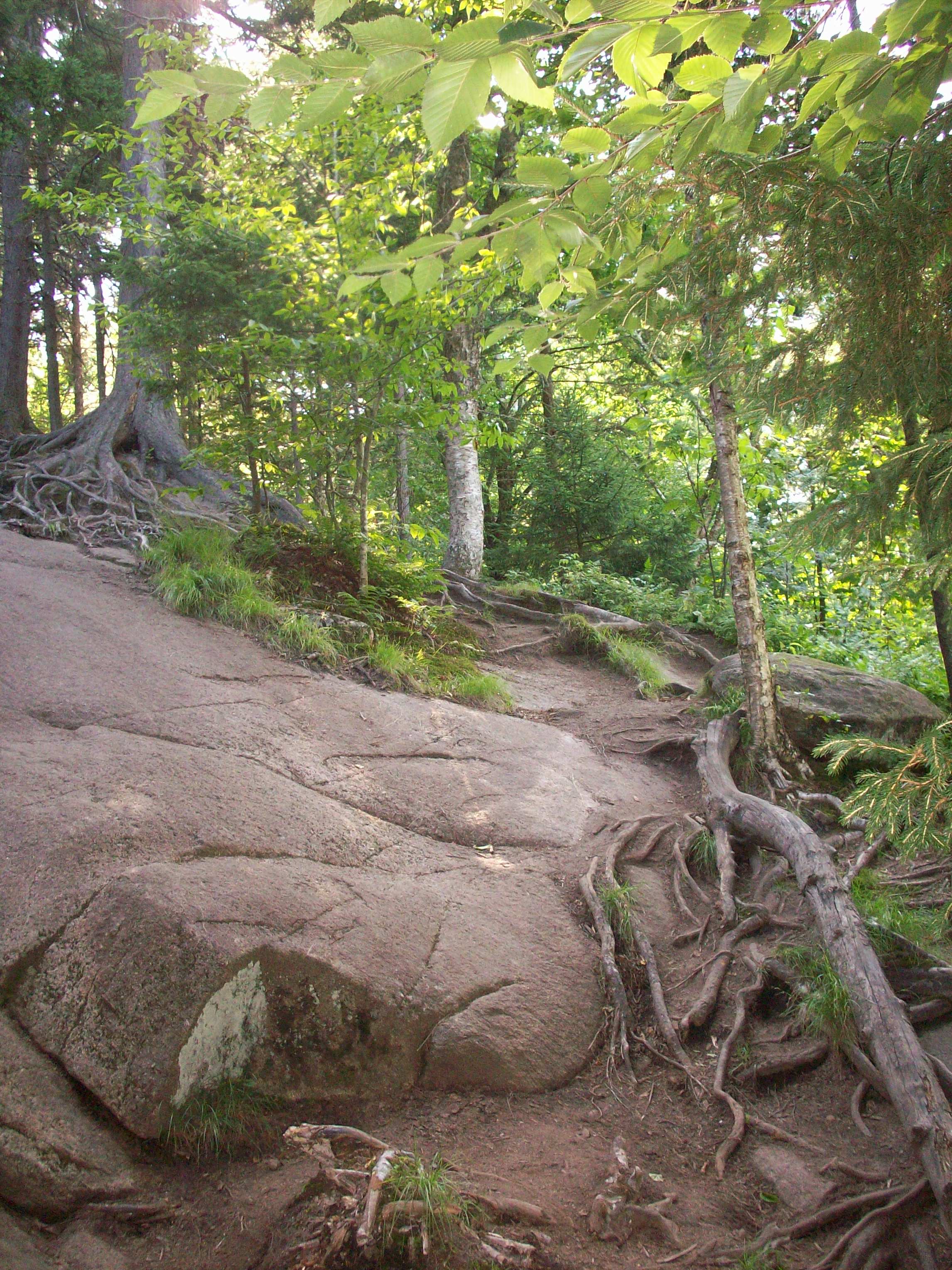
a knotty section halfway up Bald Mountain

a rooty section halfway down Bald Mountain

early, foggy morning

early, foggy morning

“Experiencing Rush: A Listener’s Companion” – full cover

Please purchase the book now. Thanks!

Experiencing Rush - full cover

Experiencing Rush – full cover

Please purchase the book now. Thanks!

P.S. Today is Geddy Lee’s 61st birthday AND the 40th anniversary of the day that Neil Peart joined Rush.

Computer Maintenance

I just ran Malwarebytes Anti-Malware (the free version) on my computer for the first time in a couple of months. It scanned 548772 objects, so I guess I’ve been more productive than I thought! I also have AVG AntiVirus (free) installed, occasionally run an older version of AVG PC Tuneup (they haven’t charged me anything to keep using it), and use EaseUS Todo Backup (free). Those are some good options, although they are less “cloud”-oriented than some of you may like. They are also not exactly fast, so run them overnight.

Website Downsizing?

I’m not sure if moving from self-hosted WordPress (which costs money for hosting) to WordPress.com (which is somewhat more limiting, but free) is “downsizing,” exactly. However, I’m now most of the way there. The URL will be https://durrellbowman.wordpress.com until my web-hosting account expires, by which point I will have reassigned http://durrellbowman.com to come here. This is also a test to see if this post gets to Facebook, Twitter, Google+, and/or LinkedIn.

Rush – Vapor Trails (2002) and Vapor Trails Remixed (2013)

I finally got around to a “Pepsi Challenge” re Rush’s album Vapor Trails (2002) and Vapor Trails Remixed (2013).  The original version was widely-discussed for being exceptionally “loud,” but I never really knew what that meant.

I can hear now that the 2002 version keeps too many of the various, heavily-layered multi-tracks (guitars, drums, bass, and background vocals) across the front and centre of the mix.  It’s almost as if someone set all songs on the album with a kind of preset to keep 80% of the composite tracks very close to the same position and volume.

Vapor Trails Remixed uses more of the stereo field, as well as wider dynamics.  One can now hear individual parts (and even instrumental and vocal effects, sometimes very quiet ones) that were almost completely buried before.  Also, many things aren’t centred nearly as much.  The lead vocal of a song is now usually the main thing that’s front and centre.  Incidentally, the songs “One Little Victory” and “Earthshine” were already available in remixed form on the Rush anthology “Retrospective III” (2009).

I listened through the two albums by interleaving them by song: AA’BB’CC’… — taking into account some of the differences I heard, but without making any specific notes.  Then, I wondered if I’d be able tell which song-version I was hearing if I set the playlist to shuffle and listened to the first minute or so of each song.  The challenge turned out to be quite difficult for me, because I can hear things like melodies, rhythms, and other structures much better than I can hear things having to do with mixing.  The former elements were not really changed at all in the remixed versions, in the same (“album rock”) way that Rush’s live song versions are very similar to its original, studio versions.  One would first have to get very familiar with the aural qualities for the “loud” version of each song on Vapor Trails, before confidently hearing the differences in its “remix” version.

The remixed album generally “sounds better,” in terms of how things are balanced.  However, I think it would also be fairly difficult for most other people to hear and explain exactly why and how that’s the case.  In any case, these are not “remixes” in the sense of substantially-revised interpretations, such as with newly-introduced material.  For Rush, the term just means “mixed over again.”  Many other musicians, though–ranging from classical string ensembles to death metal bands (and everything in between)–have re-worked Rush’s music more substantially than the band itself has.  I’ve written about that elsewhere.

The Future of Higher Education?

December 2113, at breakfast:

  • Dani (14): Hey, Daddums. What’s “philosophy?”
  • Dad: Something about the meaning of existence; your great-grandma studied it.
  • Dani: Where did she study it?
  • Mom: At UCLA, I think. Her blogkive has some gradeypost she wrote about this government arts and music ambassador in the 2030s, named Miley Cyrus.
  • Dani: Do you mean that people actually used to submit things mostly in words, and sometimes about the arts? My Business Economics Enabler-Bot-ing administrator, Master Baights, MBA in Seed Acquisition, Level 7, says university has been only about honing your entrepreneurial potential for at least the past sixty years.
  • Dad: That’s all true, my little stevia lozenge.
  • Dani: Can I study to be a doctor of philosophy?
  • Mom: Not anymore. Your great-uncle had his “Ph.D.,” but in sociology. It had to do with the early, post-postmodern, post-postindustrial history of manufacturing small electronic devices in other countries in the early decades of the 21st century.
  • Dani: That barely even QRs, Momsie. Do you mean that China used to make its stuff here? Where did he work?
  • Dad: At first, he taught a course or two at the State College of Eastern West Virginia. He was an “adjunct,” so he didn’t have access to the instructohub and mostly used his car as an office.
  • Mom: Smaller cities didn’t have subways and skytrains back then, and most of their LRTs failed and were torn out for additional efficipark structures by about mid-century. He was also on something called “food stamps.” After about ten years, he ended up at AmazoogleFedEx, working part-time as a gravlift drone-fleet pilot.
  • Dani: That QRs even less. OK, well I better get my visohelmet on and get started on my webdeck about some quaint, “hippie” thing from the 2010s, called “crowdsourcing.”
  • Dad: Surf safely!

Meet Prof. Doe

A history professor (Jonathan Rees) recently referenced the 1941 Frank Capra movie Meet John Doe. In it, a fake, world-despairing “everyman” (played by Gary Cooper) ends up having value despite being imagined into existence by a newspaper columnist (played by Barbara Stanwyck) and then being appropriated by a power-hungry aspiring politician.

Rees’ idea is that something similar is going on with the providers of online university courses (MOOCs) apparently thinking about hiring celebrity actors to “teach” their courses. It’s not a great analogy, though. For example, in the contexts of adjunct instructors and other disenfranchised academics, the world-despairing is not actually being faked at all. Tens of thousands of post-secondary courses are now being taught by academics (including thousands of Ph.D.s) who do not have offices, benefits, or pensions. Actually, some people with Ph.D.s are worse off than that:  I know, because I’m one of them.

So, someone should write a screenplay called Meet Prof. Doe. The title character would be perfect for someone like Matt Damon, especially given his early success with 1997’s Good Will Hunting. (Ben Affleck may direct the movie, but he may NOT appear in it!)

Public Music History & Culture

As I sit here starting to put together Experiencing Rush: A Listener’s Companion (2014) and look back over my dissertation (“Permanent Change: Rush, Musicians’ Rock, and the Progressive Post-Counterculture,” 2003), it’s perfectly obvious that we do lots of great research and writing for our Ph.D. dissertations.

However, despite what every academic career guide says, it’s also perfectly obvious that we should not be adapting our dissertations into academic-press products for a couple of hundred colleagues, a couple of dozen academic libraries, and (if we’re “lucky”) a couple of thousand people who will never get past the excessive jargon, overly-technical analysis, and so on.

We should be adapting our dissertations into intelligent, non-fiction books for hundreds of thousands of people in the general public, such as through thousands of bookstores and public libraries, in e-books and public talks, and so on.

There are only famous non-fiction writers (including a certain curly-haired one of my acquaintance) because 95% of academics do the former instead of the latter 95% of the time.  There are also tens of thousands of exploited adjunct instructors purely because almost no-one has bothered to figure out how to do something way more useful than that.